
· 4 min read
Why Biomechanics Should Drive Every Clear Aligner Decision You Make
Did you know most clear aligner failures are not material failures. They are planning failures. And most planning failures trace back to one thing: biomechanics being treated as an afterthought rather than a foundation. This article breaks down the key considerations every orthodontist should be building their clear aligner practice around.
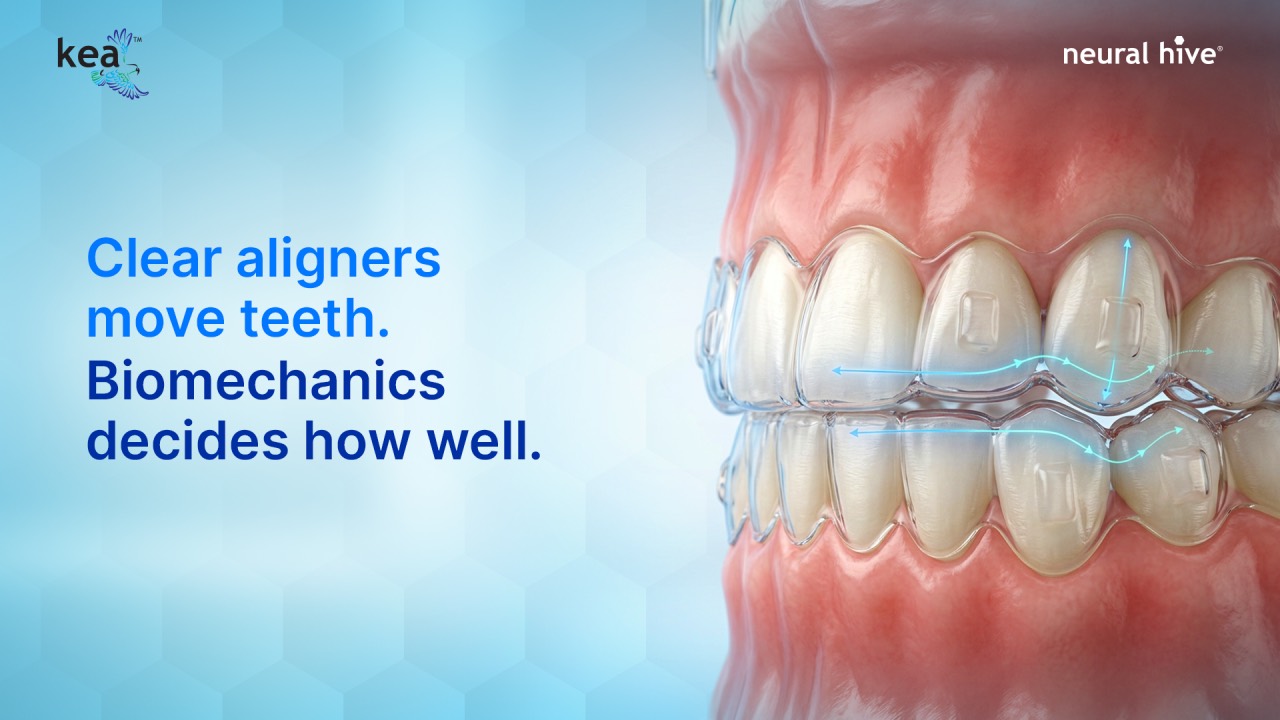
Clear aligners have transformed orthodontic practice. They have made treatment more convenient, more aesthetic, and in many cases more efficient. But as adoption has grown, so has a quiet problem that does not always announce itself loudly: cases that do not track, movements that underperform, and outcomes that fall short of what was planned.
In most of these situations, the material is not the culprit. The scanner is not the culprit. The culprit is a planning process that did not account for biomechanics carefully enough.
Clear aligners move teeth. Biomechanics decides how well.
Biomechanics is not a post-planning consideration. It is the foundation every clear aligner treatment plan should be built on.
Here are the key considerations that should be guiding your clear aligner practice.
1. Understand What Clear Aligners Can and Cannot Do
Clear aligners are exceptionally effective for a defined range of tooth movements. Tipping, mild rotations, and limited intrusion respond well when planned correctly. However, certain movements like torque, bodily translation, and severe rotations demand a level of biomechanical precision that many planning workflows underestimate.
Before staging a case, the orthodontist must have a clear-eyed assessment of what the planned movements actually require and whether the clear aligner system being used can reliably deliver them.
2. Staging Is a Biomechanical Decision, Not an Aesthetic One
One of the most common planning errors in clear aligner practice is treating staging as a visual exercise, moving teeth to where they look correct at the end rather than a clinical one.
Every staged step must reflect a logical biomechanical sequence. Which teeth need to move first to create space for subsequent movements? Where are the anchorage demands highest? Which movements risk periodontal compromise if rushed?
Staging that ignores these questions may produce a simulation that looks correct on screen but fails in the mouth.
3. Attachment Design Must Reflect the Planned Mechanics
Attachments are the biomechanical interface between the clear aligner and the tooth. They are not decorative. Every attachment placed should serve a specific mechanical purpose, whether that is generating the moment needed for torque, providing retention for a difficult rotation, or creating a point of force application for extrusion.
Generic attachment templates may be convenient but they are rarely biomechanically optimal. The most effective clear aligner plans treat attachment design as a clinical decision made case by case, informed by the specific tooth movements required.
4. Force Consistency Over the Wear Cycle Matters More Than Initial Force
A common misunderstanding in clear aligner biomechanics is equating initial clear aligner stiffness with effectiveness. In reality, what matters far more is how consistently the clear aligner delivers force across the entire wear cycle.
Materials that exert high initial force and then degrade rapidly may appear to fit tightly at the start but lose their mechanical effectiveness quickly, often within the first few days of wear. This is precisely why material selection is a biomechanical consideration, not just an aesthetic or comfort one. A tri-laminar material that maintains consistent force delivery across the full wear period translates directly into more predictable tooth movement.
5. Mid-Treatment Biomechanics Deserve as Much Attention as Initial Planning
Even the most carefully planned case will encounter unexpected responses during treatment. Teeth do not always move as predicted. Anchorage can shift. A tooth that was expected to track may not.
The orthodontist who monitors biomechanical progress at every review appointment and is prepared to replan when the clinical picture demands it will consistently outperform one who treats the initial plan as fixed. The ability to rescan, replan, and redirect treatment quickly is not a convenience feature. It is a core clinical capability.
6. The Orthodontist Must Own the Biomechanical Decisions
Perhaps the most important consideration of all: biomechanical decision-making cannot be delegated.
When treatment planning is outsourced entirely to a third-party provider, the orthodontist loses the ability to interrogate the staging logic, question the attachment design, or adjust the mechanics to reflect their clinical judgment. The plan arrives as a finished product rather than a clinical document they helped create.
The most successful clear aligner practices are those where the orthodontist is genuinely in control of the biomechanical decisions at every stage, from the first staging step to the final clear aligner in the series.
Closing Thought
Biomechanics is what separates a clear aligner plan that looks good on a screen from one that works reliably in the clinic. It is not a specialist subject reserved for complex cases. It is the discipline that underpins every clear aligner case, from the simplest to the most demanding.
The orthodontists building the strongest clear aligner practices are not just using better tools. They are asking better clinical questions and making sure the answers stay in their hands.
At Neural Hive, Kea™ was built around exactly this principle. Every step of the workflow, from segmentation to staging to attachment design, is designed to keep biomechanical decision-making with the orthodontist, supported by AI, never replaced by it.