
· 3 min read
Digital Orthodontics Isn't Just Software, It's a Skillset. And Kea Makes It Easier to Build
Clear aligner planning is often treated as a plug-and-play software task, but digital orthodontics is a discipline to master. Here's how Kea helps clinicians own case design and build that skill with every case.
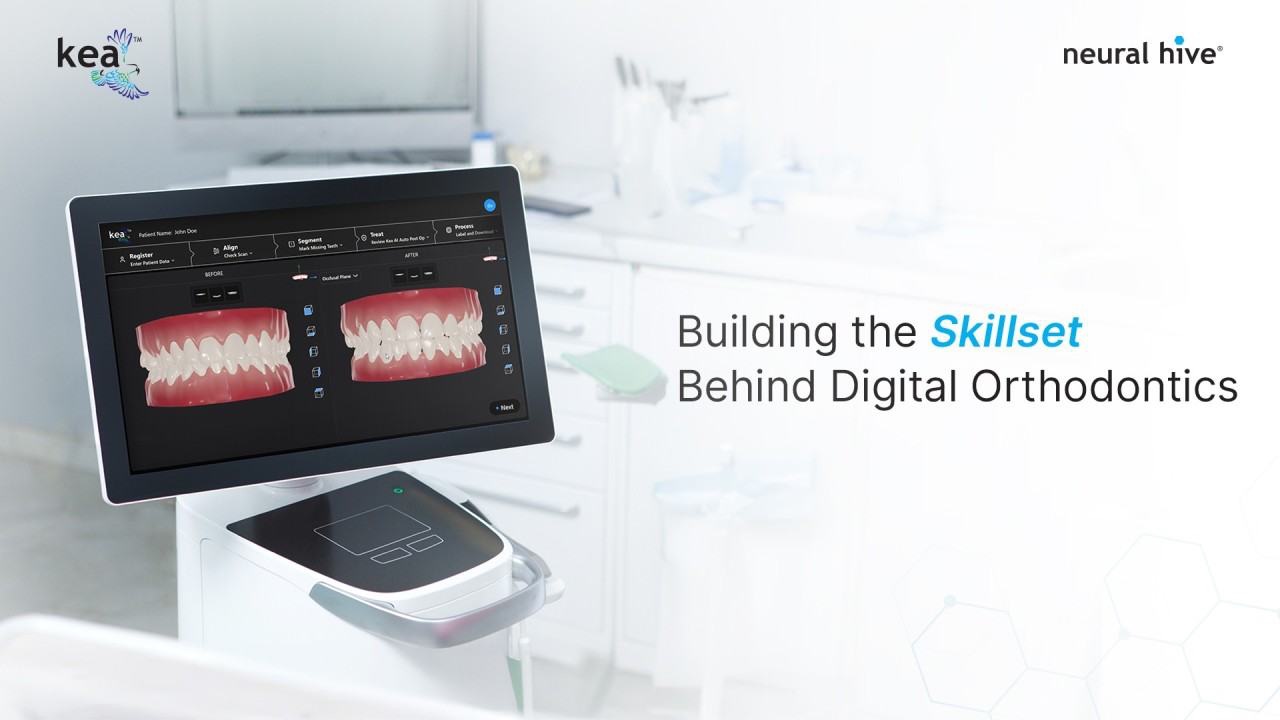
Digital orthodontics has grown faster than any other clinical segment over the last decade, with clear aligner therapy becoming a core treatment modality in practices across India. Yet the industry still treats clear aligner planning as a plug-and-play software task, upload scans, press a button, approve a simulation, and wait for trays to arrive.
The truth is the opposite.
Digital orthodontics isn't a tool you use. It's a discipline you master.
Treatment planning requires the same expertise, biomechanics understanding, force mapping, and anatomical interpretation that orthodontists apply in fixed appliance therapy. And that's exactly where most current clear aligner planning systems fall short; they automate outcomes without nurturing clinician thinking.
Kea approaches this differently.
Digital Skill-Building Requires Clinical Ownership
Most orthodontists meticulously plan brackets and wires with full control over torque, rotation, anchorage, intrusion, and staging. But for clear aligners, many are forced into a secondary role, reviewing and modifying someone else's plan rather than designing their own.
When treatment decisions are outsourced, clinical growth plateaus.
What makes Kea transformative is its clinician-first design. Its AI builds the foundational structure, accurate segmentation, ideal final outcome, staging logic, attachment selection, but the orthodontist drives the final treatment.
Instead of replacing orthodontic judgement, Kea sharpens it.
Orthodontists can:
- validate collisions
- adjust teeth position
- edit staging
- review attachment placement
- fine-tune IPR
- assess final tooth movement sequences
…all in real time, within the same platform.
The result? The doctor learns with every case. Digital expertise compounds.
Learning Through Intelligent AI Guardrails
Kea's AI isn't a black box engine. It's trained on evidence-based orthodontic principles and movement constraints. Its reinforcement learning architecture mimics the treatment decisions of experienced clinicians.
This means:
- staging respects biological force limits
- collision mapping prevents unsafe moves
- attachments are chosen based on true movement needs
- segmentation reflects realistic spacing
- movement paths are optimized to shorten clear aligner count
Every decision Kea suggests is clinically justifiable. And every time an orthodontist engages with these outputs, they refine their own skillset.
It's digital orthodontics taught by example.
Seeing the Full Digital Workflow Builds Confidence
Kea's planning ecosystem aligns with the complete digital workflow: scan, plan, print, form, finish. The orthodontist isn't only approving plans, they're understanding the full operational journey:
- how segmentation affects staging
- how staging affects clear aligner count
- how clear aligner count affects cost
- how attachments influence anchorage
- how STL integrity drives fit and comfort
This gives orthodontists end-to-end clarity over how every decision at the planning stage impacts the clinical finish.
True mastery of digital orthodontics comes from learning the chain.
Why Skill Matters More Than Software
In-house clear aligners, clinical autonomy, reduced refinements, and lower clear aligner stacks become truly possible only when orthodontists themselves are equipped to control case design. Software alone can't make that happen.
Skill does.
And Kea is a teaching platform disguised as a planning tool.
The more cases a clinician builds inside Kea, the stronger their planning instincts become:
- How much IPR is truly needed?
- Which attachments are necessary?
- Which staging sequence is the shortest path?
- When is expansion safe, and when should intrusion lead first?
- How do proximal boundaries change ideal movement?
This is clinical reasoning, not button-clicking. The platform trains decision-making, instead of creating dependency.
The Future of Digital Orthodontics Belongs to Skilled Clinicians
As clear aligners continue to overtake traditional appliances, orthodontists who understand segmentation logic, staging algorithms, inter-arch collision mapping and anatomical treatment constraints will lead the next generation of practices.
Kea helps accelerate that shift:
- Faster learning curve
- Fewer planning errors
- Real-time visualisation
- Clinically sound decision-making
- True autonomy over outcomes
Kea doesn't remove the orthodontist from the driver's seat, it gives them better controls, clearer data, and a smarter compass.
Digital orthodontics is not about outsourcing planning. It's about owning it.
And the more you build, analyze, and refine plans in Kea, the more your digital planning instincts grow. That is the real competitive advantage.
The Takeaway
Software can automate. Only clinicians can treat.
Kea elevates orthodontists from software users to digital treatment architects, building precision, confidence, and mastery in every case.
If clear aligners are the future, digital orthodontics is the language. And Kea is how orthodontists become fluent.