
· 3 min read
Mid-Treatment Corrections: The Hidden Expense Most Orthodontists Overlook
Mid-treatment refinements happen in up to 35% of clear aligner cases, quietly draining time, chair hours, and profit. Here's why they occur and how AI-driven planning prevents them.
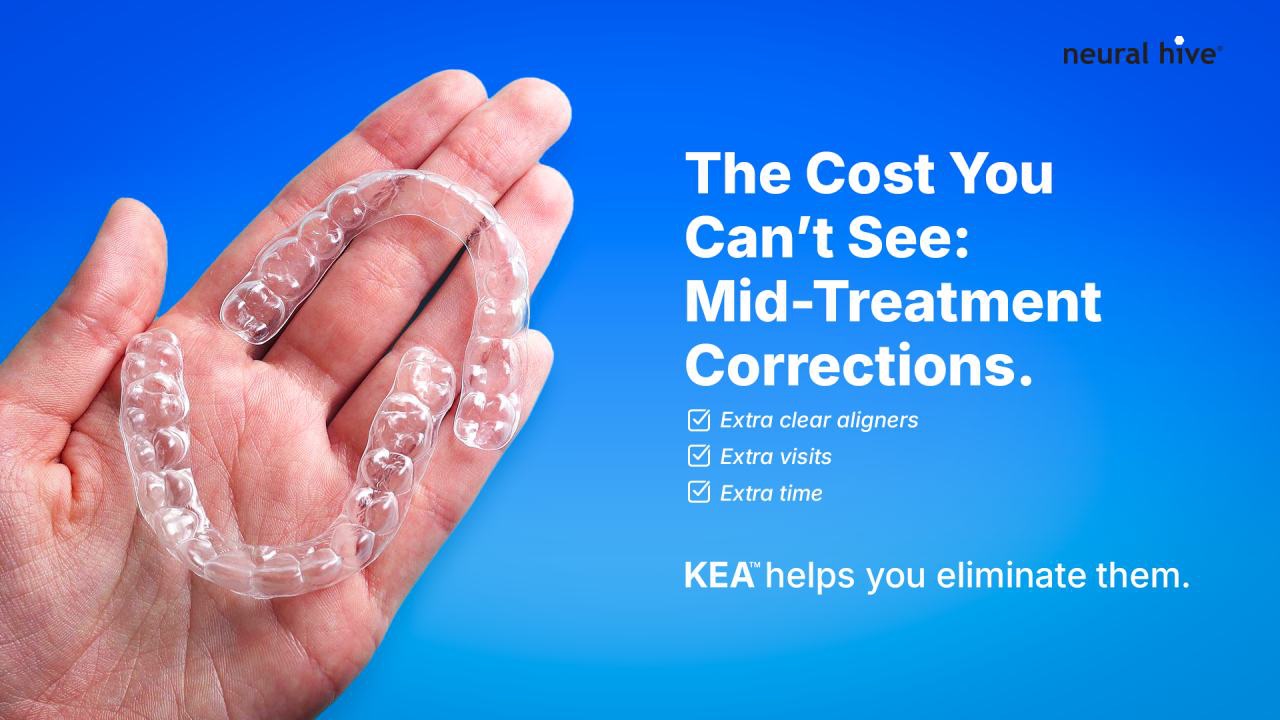
You plan a 12-month clear aligner case. But things start going off-track at month six. Suddenly, you're ordering new trays, spending extra chair time, and calming a disappointed patient. That's the hidden cost many orthodontists miss: mid-treatment corrections, and it is quietly reducing profits in clear aligner practices around the world.
What Are Mid-Treatment Corrections?
Mid-treatment corrections (also called refinements or mid-course adjustments) happen when teeth move differently from the original treatment plan.
It can happen for many reasons:
- a small tracking error,
- inconsistent wear-time,
- biological variation,
- or an imperfect initial setup.
The result? Extra clear aligners, longer treatment time, and often, a frustrated patient.
Every orthodontist has faced this. But few calculate how often it happens or how much it really costs the practice.
The Hidden Cost Inside Every 'All-Inclusive' Fee
Most clear aligner treatments are quoted as a single fee, simple and predictable for patients. But behind that simplicity, there's a complex reality:
- Extra lab fees for refinements
- More chair time for rescans, attachments, and reviews
- Longer treatment timelines that test patient patience
- Lower profitability due to unplanned clinical hours
Refinements happen in up to 35% of all cases, which means one in three patients may need extra aligners. Each refinement can cost the clinic ₹10,000–₹25,000 in time, effort, and resources that often go unbilled.
It's the cost no one talks about, but every practice feels.
Why Do These Corrections Happen So Often?
- Biological variation – not every tooth moves as the software predicts.
- Inconsistent wear-time – even small lapses can affect tracking.
- Limited monitoring – early signs of deviation often go unnoticed.
- Simplified pricing – one-fee-fits-all doesn't work for complex cases.
- Late intervention – by the time non-tracking is visible, the problem has grown.
The Other Cost: Patient Confidence
When a 12-month plan stretches to 16, patients lose trust. They start questioning the treatment plan and your expertise.
In a world where reviews and word-of-mouth matter more than ever, one unhappy patient can influence many potential ones.
How KEA Changes the Equation
At Neural Hive, our mission is simple — make clear aligner treatments more predictable and more profitable. Our AI-powered clear aligner system helps reduce refinements by predicting and correcting problems before they grow.
Here's how it works:
- Predictive Movement Modelling — AI studies past treatment data and movement patterns to spot high-risk cases early, so you can plan smarter from the start.
- Adaptive Treatment Planning — The system adjusts clear aligner designs dynamically, keeping movements within safe biological limits.
- Fewer Refinements, Higher Efficiency — Clinics using Neural Hive have seen up to 40% fewer mid-treatment corrections, saving hours of work, extra costs, and patient frustration.
Why It Matters in Cost-Sensitive Markets
In markets like India, where affordability drives most treatment decisions, every unplanned refinement matters. Each extra visit or new tray can change how patients perceive value.
Clinics that can consistently deliver predictable results without extensions or surprise costs build stronger reputations and healthier margins.
From Correction to Prediction
Mid-treatment corrections don't have to be 'part of the process.' With the right technology, orthodontists can anticipate problems, act early, and keep control over time, cost, and outcomes.
At Neural Hive, we call this Intelligent Orthodontics — where data, design, and precision work together to deliver smiles that stay on track, from start to finish.
Final Thought
Every clear aligner journey tells a story. Some have unexpected detours. Others stay perfectly on course.
AI ensures more of the latter — because the best way to fix mid-treatment corrections is to prevent them from happening at all.